What was your favorite Sustainability Studies class and why?
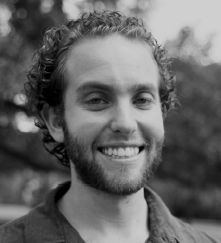
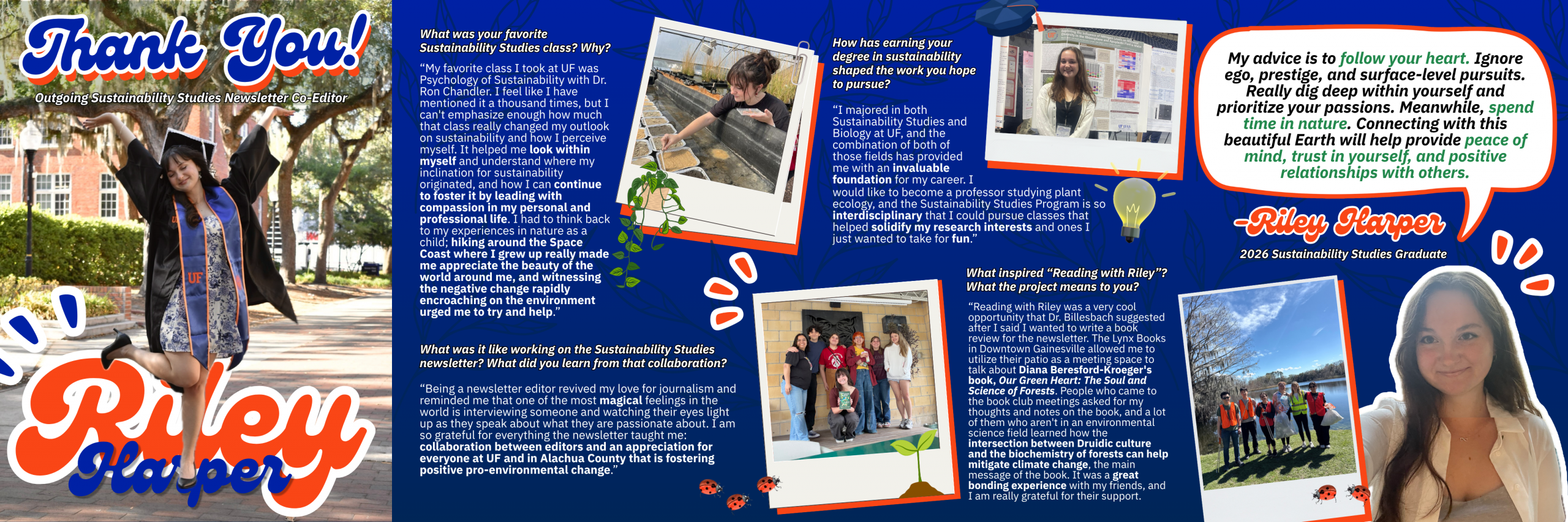
My favorite class I took at UF was Psychology of Sustainability with Dr. Ron Chandler. I feel like I have mentioned it a thousand times, but I can’t emphasize enough how much that class really changed my outlook on sustainability and how I perceive myself. It helped me look within myself and understand where my inclination for sustainability originated, and how I can continue to foster it by leading with compassion in my personal and professional life. I had to think back to my experiences in nature as a child; hiking around the Space Coast where I grew up really made me appreciate the beauty of the world around me, and witnessing the negative change rapidly encroaching on the environment urged me to try and help. A very close second is Dr. Xin Zhao’s Principles of Organic and Sustainable Crop Production class, which involved a lot of hands-on gardening that really helped me connect to sustainable agriculture and cultivate my passion for it.
What was it like working with Paige, Michelle, and Dr. Billesbach on the newsletter, and what did you learn from that collaboration?
Joining the Sustainability Studies Newsletter was one of the best decisions I ever made during my time at UF. I was only there my last year, but writing with Paige and Michelle was such a pleasurable experience. Both of them are extremely hardworking and passionate, and they inspire me endlessly. Dr. Billesbach was an amazing professor and mentor during my senior year, as he allowed so much freedom and creativity within our writing process but was always willing to lend a helping hand. Being a newsletter editor revived my love for journalism and reminded me that one of the most magical feelings in the world is interviewing someone and watching their eyes light up as they speak about what they are passionate about. I am so grateful for everything the newsletter taught me: collaboration between editors and an appreciation for everyone at UF and in Alachua County that is fostering positive proenvironmental change.
Can you tell us about “Reading with Riley” (how it began, what inspired it, and what the project means to you)?
Reading with Riley was a very cool opportunity that Dr. Billesbach suggested after I said I wanted to write a book review for the newsletter. The Lynx Books in Downtown Gainesville allowed me to utilize their patio as a meeting space to talk about Diana Beresford-Kroeger’s book, Our Green Heart: The Soul and Science of Forests. It ended up only being my friends that came to the book club meetings, but that doesn’t mean it wasn’t still an amazing experience. They asked for my thoughts and notes on the book, and a lot of them who aren’t in an environmental science field learned about the intersection between Druidic culture and the biochemistry of forests can help mitigate climate change, the main message of the book. It was a great bonding experience with my friends, and I am really grateful for their support.
Do you have a favorite newsletter story, issue, or behind-the-scenes memory from your time as an editor?
There are so many amazing memories I have with the newsletter, but some of my favorite times were just meeting with Paige and Michelle in Dr. Billesbach’s office, working out the logistics of each edition. Each of them are such wonderful human beings, and it satisfied a part of my soul to be able to work with them. They all had amazing ideas, and no matter how my day had been going, talking with them about the newsletter helped brighten my mood. I also just loved the entire stepwise process of writing an article: researching your subject, writing questions, conducting the interview, and writing the full piece. I had the opportunity to meet wonderfully kind and intelligent people that taught me something new every interview.
How has earning your degree in sustainability shaped the work you hope to pursue?
I majored in both Sustainability Studies and Biology at UF, and the combination of both of those fields has provided me with an invaluable foundation for my career. I would like to become a professor studying plant ecology, and the Sustainability Studies Program is so interdisciplinary that I could pursue classes that helped solidify my research interests and ones I just wanted to take for fun. I began UF as a pre-med microbiology student, but I did not enjoy my coursework, the clinical setting, or the competitive environment in my classes. In my junior year I switched to Sustainability Studies, and I could not have been any happier. My classmates were so kind, and I learned so much from them, almost as much as my professors.
What will you be studying in your PhD program at Florida Institute of Technology, and what are you most excited about as you begin this fall?
In August, I will begin my PhD program in Environmental Science at Florida Institute of Technology! I am really excited and very grateful for the opportunity. I will start out by taking classes and conducting research on the ecology of seagrass in the Indian River Lagoon in my advisor’s lab, as I figure out my specific research topic. I am looking forward to learning more about sustainable aquaculture and making new friends in my field!
You mentioned that your grandmother has been one of your biggest inspirations. What role has your grandmother played in shaping the person and scholar you are today?
My Nana is who I aspire to be. She is the most compassionate, selfless, and hardworking person I have ever met, and she has inspired me my entire life. I lived with her for around five years as a child and used to garden with her, so I think I tried to mimic her personality and interests in my formative years. She has supported me endlessly, and everything I do is to make her proud. She makes me try to be a better person and pursue a field where I could try to make the world around me better, just like her. She helps settle my mind and always reminds me to take everything one day at a time.
Any advice, big or small, for SS majors and minors?
My advice is to follow your heart. Ignore ego, prestige, and surface-level pursuits. Really dig deep within yourself and prioritize your passions. Meanwhile, spend time in nature. Connecting with this beautiful Earth will help provide peace of mind, trust in yourself, and positive relationships with others.
Sayri Proaño ’26 published an op-ed in the South Florida Sun Sentinel examining the environmental implications of a proposed AI data-center expansion in Palm Beach County. Graphic by Rebekah Barrera (@rebekahelize).
The Sustainability Studies graduate developed the South Florida Sun Sentinel essay in a course examining the benefits and risks of emerging technologies.
Sayri Proaño ’26 has taken work that began in a University of Florida classroom into a timely public conversation about artificial intelligence, infrastructure and environmental stewardship.
On July 13, 2026, the South Florida Sun Sentinel published Proaño’s op-ed, “Florida’s AI boom could drain its most vital ecosystem.” The piece examines Project Tango, a proposed large-scale data-center expansion in Palm Beach County, and the questions it raises about water use, energy demand, land use, public transparency and the Everglades.
Proaño developed the essay in a Sustainability and Technology course that explored both the benefits and risks of emerging technologies, including AI. Drawing on her interdisciplinary studies in biology, innovation and sustainability, she evaluates technological development through environmental, social and economic lenses.
“Innovation should not be measured only by computational power or economic output, but by whether it strengthens or weakens the systems that sustain life,” Proaño writes.
The op-ed appeared while Palm Beach County residents and officials were considering the proposed expansion. On July 15, following months of public opposition, the Palm Beach County Commission voted 5–1 to reject the pending expansion application.
Proaño’s publication reflects a central goal of Sustainability Studies: helping students connect ideas across disciplines and communicate complex issues beyond the classroom. By examining AI not only as a digital tool but also as physical infrastructure with material and ecological demands, she invites readers to consider a broader definition of innovation.
Views expressed in the op-ed are the author’s own.
Graphics by Rebekah Barrera (@rebekahelize).
Sayri Proaño ’26 reflects on how technological innovation should be measured in her South Florida Sun Sentinel op-ed about AI infrastructure and Project Tango. Graphic by Rebekah Barrera (@rebekahelize).Continue reading →
Riley Harper: What degrees did you get from UF when you were a student there?
Angela Melidosian: I’m a triple Gator, so all of my higher ed degrees are from UF. I started in 2014 as a Sustainability Studies major, of course. And then I also got a minor in Women’s and Gender Studies and Spanish. I did my undergrad in 3 years, then I went on to do the MDP program, which stands for Master of Sustainable Development Practice. That’s a 2-year program, and I got certifications in Health and Spirituality, Tropical Conservation Development and Latin American Studies. Then, I did my PhD in Interdisciplinary Ecology with a concentration in Sustainability Education, when I graduated in 2024.
Riley Harper: Where did your passion for sustainability come from?
Angela Melidosian: I spent a lot of time outside as a kid; growing up in Florida, it’s always warm enough to go outside. When I was in high school, I got diagnosed with obsessive compulsive disorder, and it was very extreme. I really struggled to leave the house, and I would just remember looking up at the treetops and feeling some of that anxiety start to melt away. I learned how important green spaces, especially trees, were for me, which kind of primed me in a way to really connect on a psychological and emotional level with sustainability.
Riley Harper: How do you think your experiences at UF helped you in your professional career?
Angela Melidosian: UF was really where I fell in love with sustainability. I was first introduced to sustainability as a concept in my senior year of high school. I was in an advanced Spanish class where one of the units we did was ‘la vida sostenible’, which translates to ‘the sustainable life’. We were watching videos in Spanish about people living off the grid in eco-housing and so many of us started to get obsessed with anti-capitalism; it was a wild ride. So, I came to UF and I wanted to go into sustainability studies or linguistics. My counselor told me in the fall, I would take Intro to Sustainability with Dr. Leslie Thiele – who went on to become my PhD committee chair – and Intro to Linguistics in the spring. I loved Intro to Sustainability so much in the fall that I never even took linguistics.
During my time as an undergraduate, I was figuring out what job I actually wanted to pursue in this field. Through my time as a student and now professor, I think that one disadvantage to sustainability degrees is that they are so broad. It’s hard for students to graduate knowing what they actually want to do with it. Luckily, I always had this desire to be a teacher. I remember being in 2nd grade when we had Open House night. We traced our bodies onto white butcher paper to make a life-size paper version of ourselves, and at the end of the day, we sat our paper people in our desks so our parents could see where we sat in our desk. I remember standing at the front of the room where the teacher usually stands and looking out into the sea of paper people saying, ‘I want to be in charge of this’.
At UF, I had one professor during my undergrad who was an amazing mentor for me. His name is Seaton Tarrant, and he really opened me up to the way that sustainability looks in real life outside of the classroom. He had a colleague come in to do a guest presentation who volunteers for Paynes Prairie Creek Conservation Cemetery. This organization is located within Paynes Prairie, and they bury bodies in a way that is environmentally positive. They also use the money from human body internment to fund and conduct conservation and restoration efforts in the prairie. And he said, ‘Hey, who wants to come and help dig a grave after class?’ So, when I needed to do something over the summer, I was living on campus and biking 12-14 miles each way through the Hawthorne Trail to work at the cemetery, and I loved it. During school, I would continue to go and volunteer there and help dig graves, especially when I could get a ride with other people. He really showed me so many cool things about sustainability, which made me want to show people sustainability in that way and help them find their niche, find their passions, and find a way to live a more sustainable lifestyle.
Riley Harper: Tell me about your creation of the Active Learning Program. It’s a keystone of the Sustainability Studies program today.
Angela Melidosian: When I was a master’s student, Dr. Thiele wanted to design an experiential learning program for undergraduate students, now called the Active Learning Program. He needed a graduate student to help design it and run the program, so we started it around 2018. All the students enrolled in the program work on a team-based internship or research project that is mentored by a UF faculty member, a UF staff member, or a UF/IFAS extension agent. They could also be mentored by someone in the community working in a nonprofit, small business, or a community organization around Florida. There is a mixture of in-person internships and research projects as well as remote, making it truly accessible. We offer this program every fall, spring, and summer. Summer term is really cool because we have students working all throughout the US since they can do things remotely that benefits communities across Florida.
We would usually do teams of 2 to 8 people, depending on the workload and what the mentors could handle. Students would also enroll in a course with me on professional development and sustainability. We would work on building the types of professional skillsets that students need to succeed in their internship and research projects, but also once they leave UF, which is something I’m super passionate about. My friends joke that my love language is professional development, because I’m always sending people jobs, webinars, opportunities, certifications, classes, anything.
I ran this program for 5 years and by the time I left, we had gone from 15 students and 5 projects a semester to 120 students and 60 projects a semester, 3 semesters a year. We would finish each semester with a poster session where I would teach the students how to create academic conference style posters, print them out, and they would present them at the end of their semester which also gave them a presentation line for their CVs. UF really helped me in the transition towards my professorial career when I became both a program coordinator helping to create the internships and design, teach, and evaluate course components over time.
I am now teaching at George Washington University, and I got to work with Dr. Billesbach to teach him all the systems that I would recommend to make this program function. We keep in contact, so it’s been great to see how that program has continued to develop over time. I think the symposium is now not just for active learning program students, and I think that’s super cool that they’ve been able to expand that program even more in the 3 years since I’ve left.
Riley Harper: How do your students receive your sustainability curriculum at George Washington University? Do they all have broad interests, and want to pursue different things?
Angela Melidosian: I am going on to my third year at George Washington University, and I am the main instructor for the Sustainability minor. We have a similar structure to the Sustainability Studies program at UF. There is an Intro to Sustainability course that all our sustainability minors take, structured around the United Nations’ Sustainable Development Goals (SDG). Each week, I teach around 120 students one to two SDGs, have them pick one country in the world and look at what their country is doing well and challenges they’re currently tackling- what barriers are preventing progress. A lot of students have gone on to study abroad programs for the countries that they researched, because they got really interested in them, and I think that’s a super cool connection.
I also teach special topics courses, including Environmental Ethics and Justice, Gender and Sustainable Development and my personal favorite, Grateful Death. This is all about how humans can die in ways that are psychologically, emotionally, socially, and environmentally healthy. I’ll talk more about this later.
Our minor finishes with a capstone project, a class I also teach. It’s a lot of the same curriculum that I originally used for the active learning program, where the students are doing sustainability-rated internships or research projects. At the end of the semester, I facilitate a poster session for everyone to present on their final projects. We have an organization called Planet Forward based out of George Washington University, and it’s a sustainability storytelling organization with a nationally attended conference every year in the spring. We actually have the spring poster session as an event within the summit. There are students, faculty, staff, and sustainability professionals in publishing, journalism, and communications all throughout the US to see our students present their posters. All the students come in kind of nervous, but at the end of the session, they’re all smiles. I’ve had students schedule coffee or lunch chats with someone they’ve met and wanted to network with.
The final other big way I connect with students at GW is what I do as the faculty coordinator for our Sustainability Living Learning Community, which is a community of first year students that live together on our Mount Vernon GW campus taking sustainability courses together. I also plan multiple events a month geared around sustainability and professional development that they get to attend. For example, we have visited the French Embassy for their event celebrating the 10th anniversary of the Kyoto Protocol, our international climate agreement. We also had a private tour of the German Embassy a couple months ago, regarding their sustainability and energy use. We have a lot of fun and I really get to support these students, as a program coordinator instructor and as an advisor, all throughout their first year.
Riley Harper: Lastly, I’d love if you could retouch on your Grateful Death course. How are death and sustainability intertwined, in your opinion?
Angela Melidosian: I started at Prairie Creek Conservation Cemetery around the same time as my dear friend, colleague and sustainability studies alum, David Ponoroff, who eventually became Assistant Director. In between the first and second year of my master’s, I worked with ALCP, the regional organization for Latin American Palliative Care, and I did an overall research assessment of palliative and hospice care in Argentina. I published this as a manual that was spread throughout Latin America that people could read to get a sense of the wrong kind of palliative care and hospice provision in Argentina.
Eventually, I integrated death and dying into my research interests, and I think my Grateful Death course links to sustainability in two ways. The first being the environmental impact of the way that we deal with dead bodies and the second way is through the SDGs. SDG 3 is stated to be about good health and well-being for all at all ages, yet the primary focus of attention, research, funding and implementation for STG 3 projects is for maternal health and children under the age of 5. We concentrate a lot of our healthcare for sustainability there, but we really aren’t doing much for end-of-life care provision.
There are a lot of impacts when someone is preparing to die or dies unexpectedly, right? There’s the psychological, spiritual, and existential experience of dying for that person. But then for their family, friends, neighbors, even people they work with, there is also the grief element – emotional and psychological elements of navigating that transition with them, navigating their death, and dealing with the body afterwards. And there’s also at the society level. That person had roles in their communities and in their workplaces, and now those roles are empty. How as a society do we cope with that?
In thanatology or death studies, we talk about this idea of having a ‘good death’. I extend this idea to be not just about the person who was dying and the people in their circle, but also about the planet itself. We can connect this idea of dying a good death to health and wellness at the end of life, to SDG 3. I would look up the green burial movement in the US, which is all about making death more environmentally positive. But it is also about the psychological, emotional, and existential benefits of getting families, loved ones and even the dying person more involved in death care practices and how that gives us psychological benefits and helps us heal after loss.
This interview has been edited for length and clarity.
With the vast amounts of paths sustainability students can take to engage in climate action, it is easy to become overwhelmed. The interdisciplinary nature of UF’s Sustainability Studies program may ignite many passions, as was the case with alumna Sofía Aviles.
Aviles graduated from UF with a double major in Sustainability Studies and Political Science, as well as minors in Economics and Agricultural and Natural Resource Law.
Her drive to complete all four programs illustrates the enthusiasm she felt towards becoming an expert in climate and energy. However, this enthusiasm didn’t stop at her classes. Aviles acted as co-president of the Sunrise Movement and as a co-founder for UF’s Green New Deal. When asked about these experiences, she emphasized the importance of collaboration, and the role community plays in enhancing environmental projects. She believes that getting involved with these organizations is a great way to learn. She recalls being thrown into it, which she says ended up being perfect, as there is “no gradual way” to get involved.
Aviles took her climate knowledge further out into the Gainesville community by working as a climate intern — and eventually resiliency project coordinator — for the Alachua County Environmental Protection Department, where she helped draft and implement the county’s Climate Action Plan. She used her experience at the EPD as an example of how to overcome obstacles in sustainability everywhere, not just in Gainesville. She advised students to find the balance between directly challenging authority for environmental reform and finding alternatives within the system to navigate the barriers.
Although the challenges can be exhausting, Aviles wants to remind people that giving up on the environment is not an option. She believes sustainability students are privileged with the opportunities presented to them through environmental education. By studying the environment and its hardships, sustainability students have the chance to work towards a better future, especially for those who can’t.
Aviles reflects on the educational opportunities she took through her political science, economic, and sustainability classes at UF. There are so many paths towards sustainability, through science, finance, policy, and more, she said, encouraging students to engage in some form of environmental education to strive for dream environmental careers.
Identifying one’s climate story can be a big motivator for continuing to fight. For Aviles, her climate story culminated with Hurricane Maria in her homeland, Puerto Rico. The substantial power outages that followed the storm propelled her towards wanting to specialize in energy law to help make a transition to renewable energy. To achieve this, Aviles is now an Environmental Mission Scholar in the Vermont Law and Graduate School’s JD/Master’s program in Energy Regulation and Law.
Sustainability students can be the catalysts of change we want to see in the world. By pursing both a master’s and law degree specializing in energy, Aviles will be making a direct impact in the realm of green policy. She stands out as an exemplary UF alumna working towards solutions for complex environmental and social challenges.
BA ’25 Liberal Arts and Sciences (Major: Sustainability Studies)
Cameron Delgado graduated from UF in Summer 2025 where she earned a Bachelor of Arts in Sustainability Studies. She is currently a candidate for the Master of Science in Environmental and Sustainability Management program at Georgetown University. In her interview, she speaks about her experience being the previous newsletter editor, along with her opinions on the importance of implementing sustainability in careers, lifestyles and educational institutions.
BA ’13 Liberal Arts and Sciences (Majors: Sustainability Studies and Political Science)
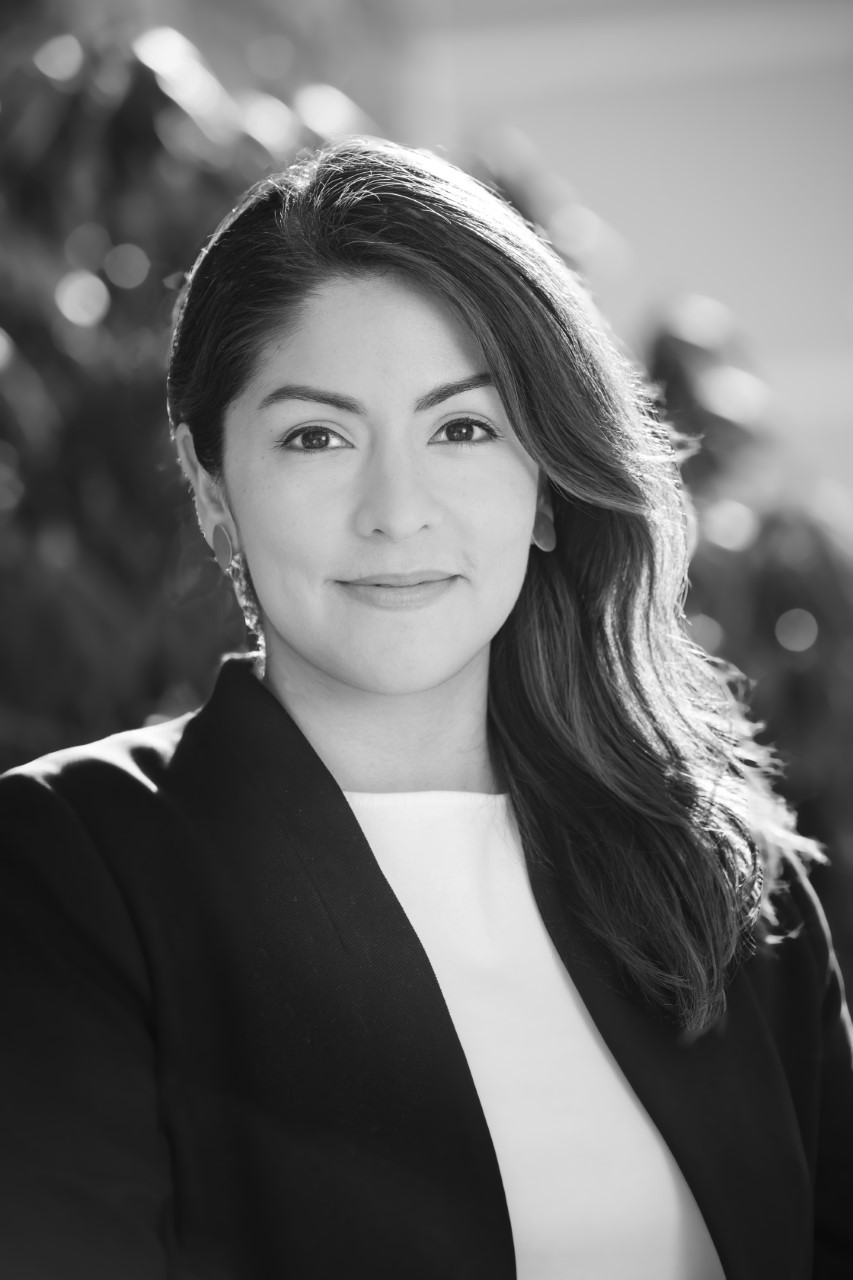
Maria leads Breakthrough Energy’s clean fuels portfolio and provides policy and advocacy expertise to advance the drive towards a net-zero economy. Prior to joining Gates Ventures and Breakthrough Energy, Maria served as Special Assistant to the Commissioner of the Connecticut Department of Energy and Environmental Protection (DEEP) where she led in the planning, development, and execution of agency policy. While at DEEP, she oversaw implementation of an Executive Order which expanded the scope of the Governor’s Council on Climate Change (GC3) to address climate change mitigation and adaptation in the state. Before DEEP, Maria worked in the Washington D.C. office of the Natural Resources Defense Council on international climate policy and cross-programmatic strategy.
Maria holds a Master of Environmental Management degree from Yale University and a B.A. in Sustainability Studies and Political Science from the University of Florida. While at UF she was actively engaged with the College Democrats, the Office of Sustainability, and Gators Going Green, where she planned the annual Student Sustainability Summit. She interned with the Alachua County Commission, was Sustainability Coordinator for the Young Entrepreneurs for Leadership & Sustainability (YELS) Program and served as undergraduate Research Assistant for Dr. Thiele.
BA ’12 Liberal Arts and Science (Major Sustainability Studies)
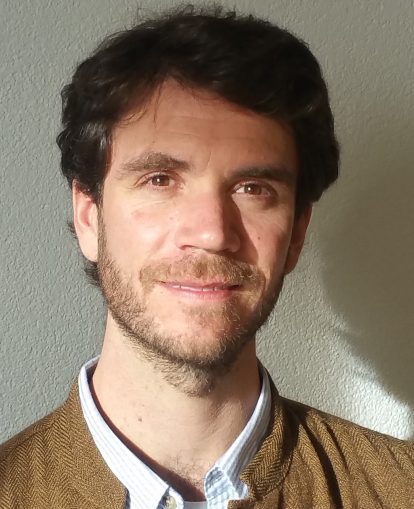
Timothy graduated in 2012 with a major in Sustainability Studies, after interning at Swallowtail Farm and Prairie Creek Conservation Cemetery. Marrying a women he met in his travels in Switzerland, he moved there in 2014 and became a father. Although it took some time to learn the language and adjust to a new a country, Timothy is feeling integrated and at home now in Switzerland, where he is an active member of a local environmental group that turns conventional farm land into habitat for wildlife through the construction of ponds, the planting of native hedges and trees, and the removal of nutrient rich topsoil – allowing native groundcovers to thrive. Timothy is a Train Traffic Controller at the Swiss Federal Railways (SBB). Additionally, he works as a meditation teacher and Life-Coach and serves as the Treasurer for ManKindProject Switzerland.
BA ’15 Liberal Arts & Sciences (Major: Sustainability Studies and Women’s Studies)
Rebekah graduated from the University of Florida in 2015 with degrees in Sustainability Studies & Women’s Studies. During her time as a student she was a volunteer at the Rural Women’s Health Project, an environmental education intern at the Tuscawilla Prairie Learning Center and a teaching assistant for courses in sustainability & social entrepreneurship. Since graduating, she has worked as an environmental educator in a variety of settings. She has led middle school students on backpacking trips on the Appalachian Trail, taught stream ecology to elementary school students at a nature center in Georgia and led coastal hikes for high school students on the shores of the Pacific.
BS ’14 Liberal Arts & Sciences (Major: Sustainability Studies), BA ’14 College of Journalism and Mass Communications (Major: Journalism)
Kelsey graduated from the University of Florida in 2014 with bachelor’s degrees in Sustainability Studies and Journalism. During her time at UF, she worked as a freelance journalist and photographer, often covering stories about solar energy, composting and other environmental topics. She also interned with UF’s Sustainability Studies department and with Holbrook Travel, where she helped promote ecotourism and educational environmental studies trips.
BA ’12 Liberal Arts and Sciences (Major: Sustainability Studies), BS Warrington College of Business (Major: Accounting)
Jonathan Davis graduated from UF in 2012 with a BA in Sustainability Studies and a BS in Accounting. While at Florida, Jonathan interned with the consulting firm Carbon Solutions, serving as a research assistant to the Gainesville-based firm that specializes in carbon accounting and management. Prior to studying abroad in Argentina, Jonathan sat on the board of UF Hillel, served as an editor for the Fisher School of Accounting Newspaper, and participated in the United Way’s Alternative Spring Break.


 ugh Energy’s clean fuels portfolio and provides policy and advocacy expertise to advance the drive towards a net-zero economy. Prior to joining Gates Ventures and Breakthrough Energy, Maria served as Special Assistant to the Commissioner of the Connecticut Department of Energy and Environmental Protection (DEEP) where she led in the planning, development, and execution of agency policy. While at DEEP, she oversaw implementation of an Executive Order which expanded the scope of the Governor’s Council on Climate Change (GC3) to address climate change mitigation and adaptation in the state. Before DEEP, Maria worked in the Washington D.C. office of the Natural Resources Defense Council on international climate policy and cross-programmatic strategy.
 Timothy graduated in 2012 with a major in Sustainability Studies, after interning at Swallowtail Farm and Prairie Creek Conservation Cemetery. Marrying a women he met in his travels in Switzerland, he moved there in 2014 and became a father. Although it took some time to learn the language and adjust to a new a country, Timothy is feeling integrated and at home now in Switzerland, where he is an active member of a local environmental group that turns conventional farm land into habitat for wildlife through the construction of ponds, the planting of native hedges and trees, and the removal of nutrient rich topsoil – allowing native groundcovers to thrive. Timothy is a Train Traffic Controller at the Swiss Federal Railways (SBB). Additionally, he works as a meditation teacher and Life-Coach and serves as the Treasurer for ManKindProject Switzerland.
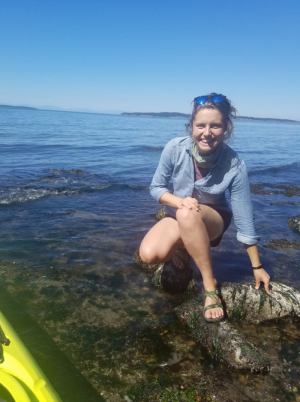 Rebekah graduated from the University of Florida in 2015 with degrees in Sustainability Studies & Women’s Studies. During her time as a student she was a volunteer at the Rural Women’s Health Project, an environmental education intern at the Tuscawilla Prairie Learning Center and a teaching assistant for courses in sustainability & social entrepreneurship. Since graduating, she has worked as an environmental educator in a variety of settings. She has led middle school students on backpacking trips on the Appalachian Trail, taught stream ecology to elementary school students at a nature center in Georgia and led coastal hikes for high school students on the shores of the Pacific.
 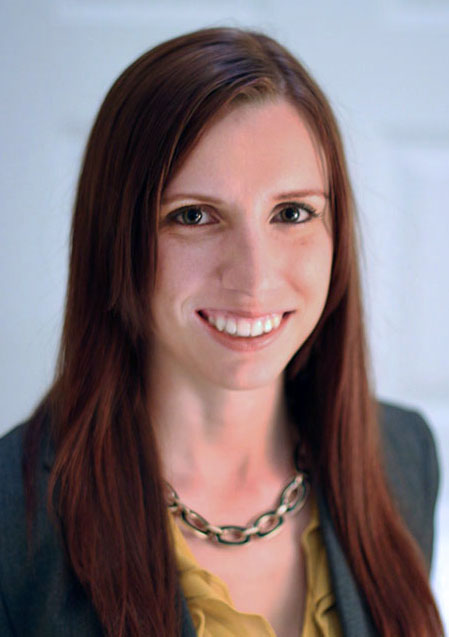 Kelsey graduated from the University of Florida in 2014 with bachelor’s degrees in Sustainability Studies and Journalism. During her time at UF, she worked as a freelance journalist and photographer, often covering stories about solar energy, composting and other environmental topics. She also interned with UF’s Sustainability Studies department and with Holbrook Travel, where she helped promote ecotourism and educational environmental studies trips.